Cloud providers secure the infrastructure, but your business is always responsible for configuration and access control. Assuming full protection from managed cloud solutions can leave you open to breaches you thought were covered.
Picture a logistics firm in Coopers Plains that moved its records to the cloud last year and assumed the provider's security team now watched over everything. That assumption is where the trouble starts.
The truth sits somewhere less comfortable. Providers lock down the servers, the network hardware and the infrastructure beneath your applications, but the moment you start configuring that environment, the job becomes yours. Who gets access, how permissions are set, what data sits where — these decisions never leave your desk, and assuming otherwise is how gaps appear.
A single misconfigured setting or a weak access control can expose sensitive data even when the infrastructure underneath is flawless. That is not a small risk either: 45% of all data breaches have been cloud-based, with an average cost of just over $5 million per breach.
So the task becomes knowing precisely where the provider's job ends and yours begins, because that boundary is what keeps a business safe and compliant.

The shared responsibility model is the framework that draws that boundary, splitting security duties between a business and its cloud provider.
Providers like Microsoft Azure or Amazon Web Services look after the physical servers, the network hardware and the underlying cloud infrastructure, keeping those systems patched, monitored and shielded from outside threats.
Once that infrastructure is in place, though, the configuration work starts, and that work belongs to the business: how applications are set up, who receives access, what data gets stored where. User permissions, password management, security features — all of it sits on your side of the line.
Misread that split and parts of the environment can sit exposed without anyone noticing. A storage bucket left open to the public, for instance, is a risk no provider will quietly fix on your behalf.
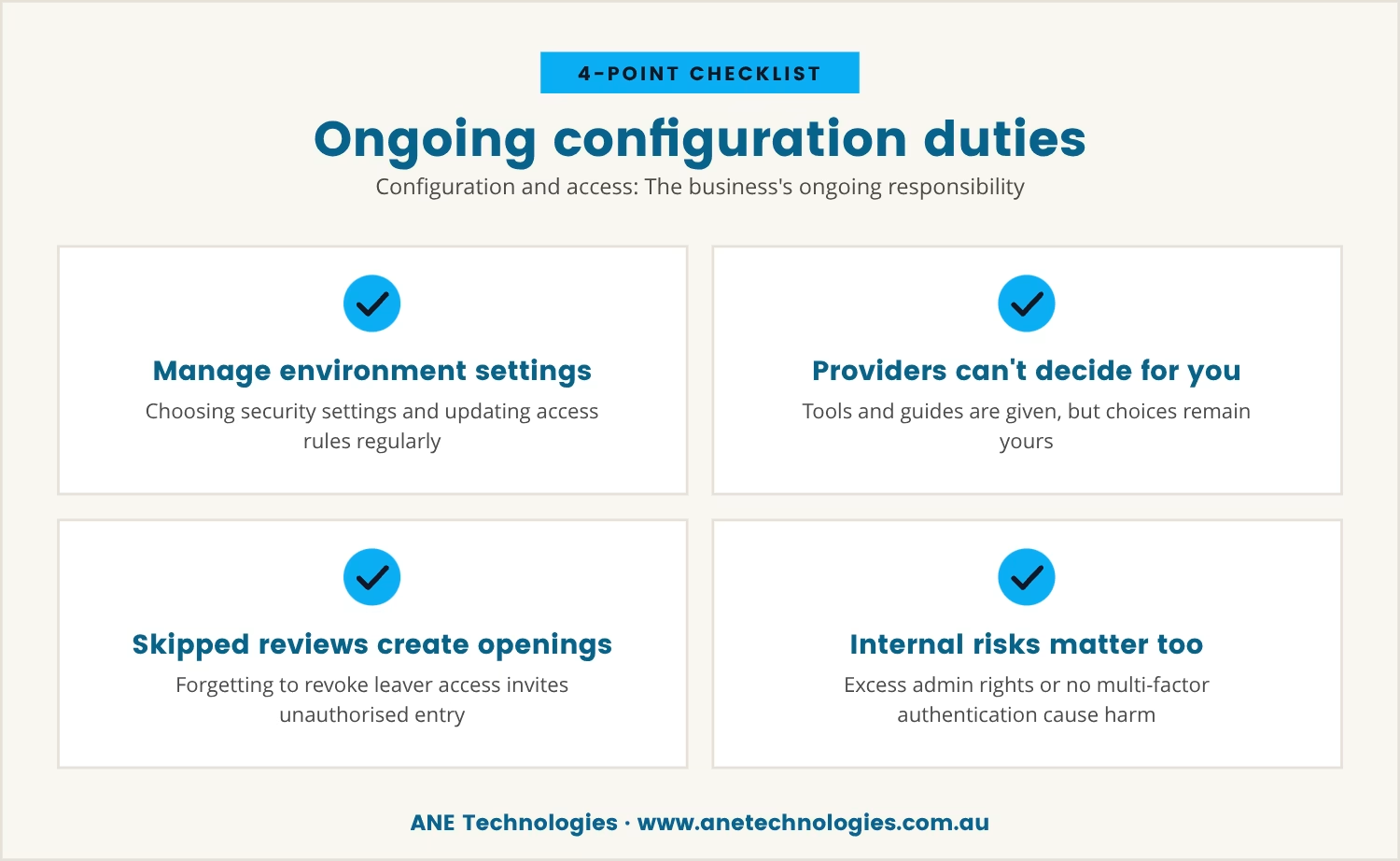
Even with managed cloud services in place, a team still has to actively manage how the environment is configured — choosing the right security settings, updating access rules and regularly reviewing who can see or change data.
Providers can hand over tools and best-practice guides, but they cannot make these calls for you. Skip the regular reviews, or forget to revoke access when staff leave, and those small oversights become openings for unauthorised entry.
Often the gap only becomes visible after something has already gone wrong. If the cloud settings haven't been checked in months, what might turn up?
Hackers aren't the only threat here, either. Handing out too many admin rights, or simply never switching on multi-factor authentication, does just as much damage.
Businesses across Coopers Plains are turning to managed cloud solutions to simplify IT and support growth, and that trend makes sense given the workload a good provider lifts. But even with a provider managing the infrastructure, local teams still need to stay alert to the security tasks that remain theirs.
Australian regulations and compliance requirements mean responsibility can't simply be handed off wholesale. Data has to be protected according to local law, which often calls for steps that go beyond whatever the provider supplies.
A provider can support some of that compliance work, but only the business itself understands its specific risks and internal processes. That is exactly why regular internal reviews and staff training matter.
Many breaches trace back to a misunderstanding of where responsibility sits within the shared model. The most common gaps look like this:
Every one of these gaps closes with regular checks and clear internal processes — the fixes are rarely complicated, just easy to neglect.
Given those common gaps, protecting a cloud environment comes down to a handful of habits practised consistently rather than any single fix.
Check who has access to cloud resources at least once a quarter, and remove permissions for anyone who no longer needs them.
Enable multi-factor authentication for every user, so a stolen or guessed password alone isn't enough to get in.
Set up monitoring tools to flag unusual behaviour, such as failed logins or unusually large data downloads, and respond quickly when alerts fire.
Give each user only the access their role requires, and resist the temptation to make everyone an administrator.
Keep a record of the cloud setup, including security settings and changes, so issues are easier to spot and improvements easier to track over time.
Watch for new security features or changes from the provider, and apply updates promptly to keep the environment secure.
Of all these habits, access control is where oversight tends to carry the heaviest price. Once unauthorised users slip through, the result is breaches, financial loss and lasting damage to reputation.
Even one small miss — forgetting to remove an ex-employee's credentials, say — creates exactly the weak point attackers go looking for.
That's why access control can't be treated as a one-off task. It needs regular attention, especially as teams change or a business grows, and while automated tools help, human oversight is still what catches the mistakes the tools miss.
That human oversight matters because managed service providers, however capable, have limits of their own. They maintain infrastructure and offer sound advice, but they cannot know a business's internal processes and unique risks the way the business itself does.
They can recommend best practice, but applying it is a judgement call that stays with you — deciding, for instance, which staff can reach financial records or customer data.
Leaning entirely on a provider is how blind spots form. Closing them means staying actively involved in how the cloud environment is managed, rather than stepping back once the migration is done.
Managed cloud solutions make IT simpler, but simplicity doesn't extend to configuration and access control — that responsibility stays put. The provider secures the foundation; the business decides who can enter and what they're allowed to do once inside.
Assume the provider covers everything and critical security steps get missed. Regular reviews, clear processes and staff training remain the strongest defence against breaches.

If your business has 1 to 40 users, you might be relying on managed cloud services and wondering where your own security tasks begin and end. At ANE Technologies, we understand how easy it is to overlook the parts of cloud security that remain in your hands.
We invite you to talk with us about how we approach shared responsibility and what that means for your setup. Let’s make sure you have the clarity and support you need to protect your business.
If we ever miss a commitment to you, you’ll receive a $170 service credit—no questions asked, just our way of keeping your trust.
A regular cloud provider supplies the basic infrastructure and tools for building and managing a cloud environment independently. A managed cloud service provider goes further, handling maintenance, monitoring and support for those systems. Even then, the business remains responsible for how the environment is configured and who can access it.
Start by planning which data and applications need to move, then work with the provider to build a step-by-step migration plan and test the setup before going live. Getting security settings right from the start matters, and clear documentation plus steady communication with the team helps avoid confusion and cut downtime.
Managed cloud solutions often include automated backups and quick restoration options, which means data can be recovered faster when something goes wrong. Backup settings still need to match the business's actual needs, though, and the recovery process is worth testing regularly rather than left untested until it's needed.
Look for a provider that understands the relevant industry, offers strong security features and provides clear support options, and ask how they handle compliance with local regulations and software updates. Knowing in advance which security tasks belong to the business and which the provider covers prevents confusion later.
Compliance means following the laws and industry standards that govern data protection, and using cloud solutions doesn't change that obligation. A provider can assist with parts of this requirement, but responsibility for how data is used and who can access it ultimately stays with the business.

With 20 years of industry experience and a strong background in business operations and process analysis, Rob understands how technology can be applied practically to improve commercial systems, workflows, and outcomes.

We help small businesses in Coopers Plains, Brisbane and across South-East QLD thrive with expert IT support.
Our engineers are experienced and committed to your success.