A missed or late incident notification under CPS 234 can harm a business relationship with a regulated client more deeply than the security incident itself. The loss of trust and commercial fallout can last far longer than any technical fix.
A missed notification deadline rarely stays a technical footnote - it becomes a commercial event. Projects stall, decisions get delayed, and contracts due for renewal suddenly face fresh scrutiny, all because a partner didn't report an incident on time.
That delay doesn't just cost time. It chips away at confidence in your information security controls, and the real expense often surfaces much later, when a client quietly decides not to renew or starts shopping for a more dependable partner.
CPS 234 exists precisely to close that gap. It sets the standard for information security across APRA-regulated entities, requiring timely incident notification, robust security controls and a clear-eyed view of which information assets are critical and sensitive. The rule is meant to protect the financial services sector from genuine threats - but how you handle the reporting side of it does just as much to shape your reputation as the incident itself.

It's tempting to treat the technical fix as the whole job, but for an APRA-regulated client, the timing of your notification can matter more than the fix itself. If that client hears about an incident from someone else, or hears about it too late to act, the question in their mind shifts from "what happened" to "can we still rely on this partner".
That doubt doesn't dissolve once the technical issue is resolved - it tends to linger, because clients need confidence that they'll be kept informed, particularly when their own compliance obligations are riding on it. Miss that mark, and you risk being recast as the weak link in their information security chain.
The bar sits especially high for businesses in Coopers Plains, where many clients operate under APRA CPS 234 compliance and expect communication that is both prompt and transparent. One misstep here can trigger awkward conversations and a loss of trust that takes far longer to rebuild than the incident took to fix.
That loss of trust has a price tag, and it shows up first in contract reviews. A client who learns of an incident too late may start benchmarking you against providers who can prove stronger compliance and clearer communication, putting the relationship itself up for renegotiation.
It rarely stops there. Missed notifications often trigger internal audits on both sides, and those audits have a habit of surfacing other compliance gaps, compounding the reputational damage well beyond the original incident. The technical problem might be solved within days, but the impression of unreliability tends to outlast it.
This sensitivity runs deepest in financial services, where clients carry their own regulatory obligations and simply cannot afford to be exposed by a partner's oversight. One notification failure, in that context, can be enough to cost you new business or an existing contract's renewal.
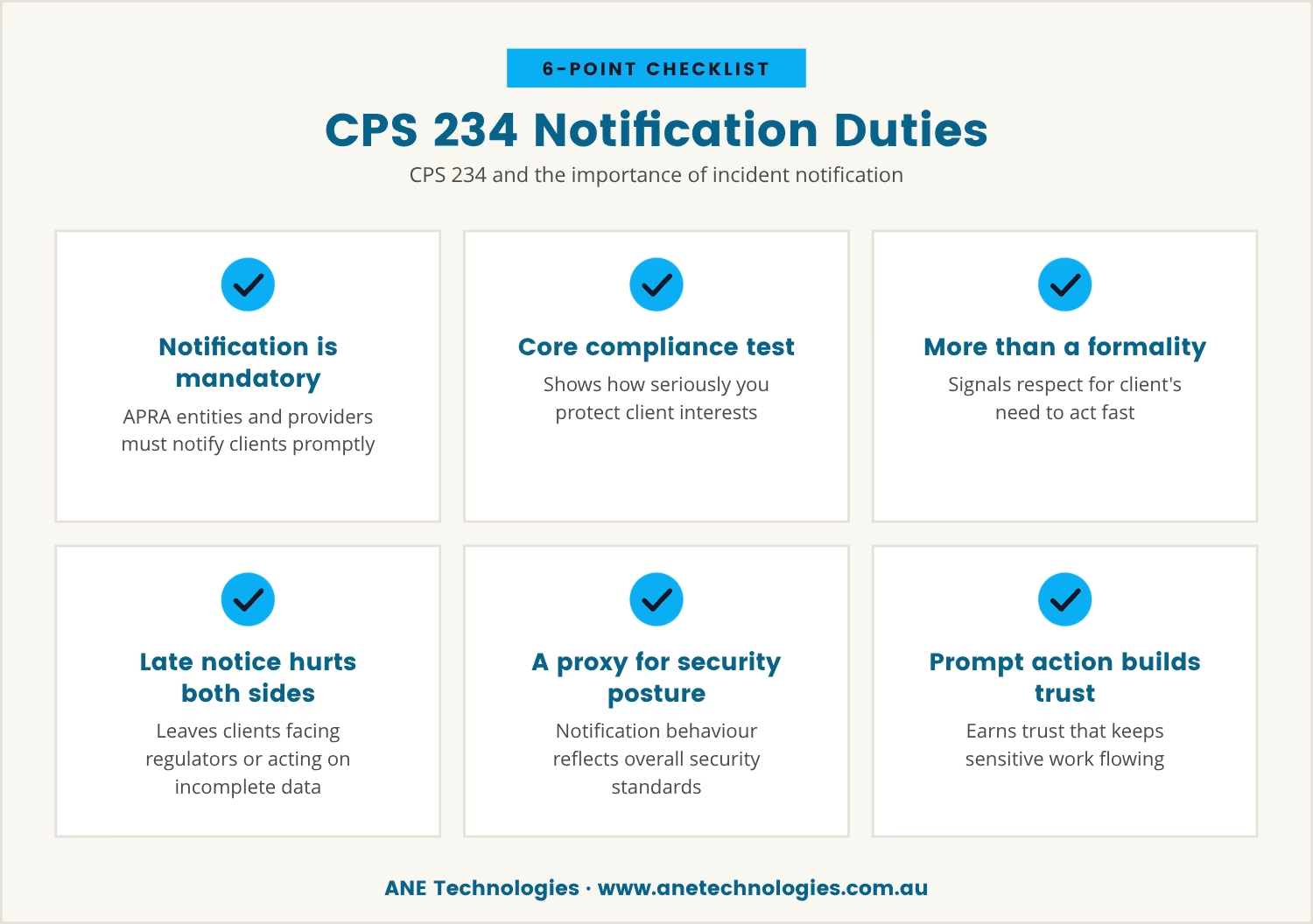
CPS 234 is explicit on this point: APRA-regulated entities and their third-party providers must notify clients of information security incidents as soon as possible, and that timeliness is not negotiable. It sits alongside the other requirements as a core test of compliance and of how seriously you protect a client's interests.
Seen that way, notification is more than a box to tick - it tells the client you take their security seriously and respect their need to respond to threats without delay. Notify late, and you leave them explaining that delay to regulators or acting on incomplete information, neither of which reflects well on either party.
That's precisely why notification behaviour is read as a proxy for your whole security posture. A provider who communicates promptly earns the kind of trust that keeps sensitive information assets flowing their way in future.
A missed or late notification under CPS 234 can strain even the strongest business partnerships, and the damage tends to unfold along a few predictable paths.
Clients expect to hear about incidents affecting them without delay. The moment that notification is late, confidence in your reliability drops straight away.
A pattern of late notifications gives clients reason to think twice before renewing. Many will start looking at providers with a stronger compliance track record instead.
A missed notification often sends clients back to their own risk management processes to check for gaps. That scrutiny can bring stricter oversight or new requirements for your business.
In regulated sectors, clients compare notes more than you might expect. A reputation for poor communication travels fast and makes new business harder to win.
Repeated notification failures can draw the attention of the Australian Prudential Regulation Authority. From there, audits or penalties become a real possibility, adding another layer of damage.
Even once the technical fix is complete, rebuilding trust takes real time and resources. The commercial fallout from a notification failure routinely outlasts the incident that caused it.
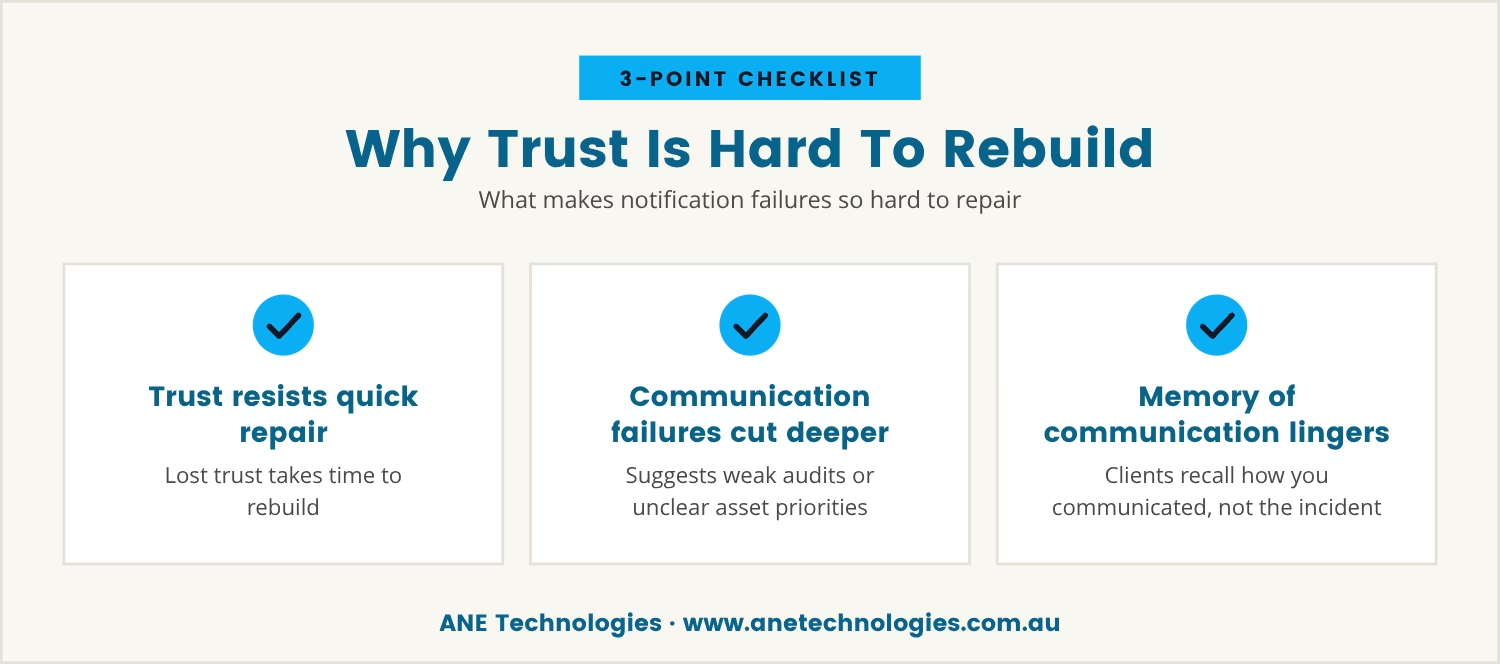
That slow recovery points to something deeper: trust, once lost, resists quick repair. Clients will often forgive a technical mistake if the response is open and proactive, but a failure to notify suggests something harder to dismiss - gaps in internal audit processes, or a shaky grasp of which information assets are truly critical and sensitive.
What sticks in a client's memory is usually the communication, not the incident itself. That memory can translate into tighter risk assessments, demands for extra security controls, or a quiet decision not to renew at all.
How confident are you that your current notification processes would stand up to scrutiny if an incident occurred tomorrow?
Those steps matter most for third-party providers, who face a particular kind of pressure when working with APRA-regulated entities. Clients depend on them not only for technical solutions but for compliance support, so a single lapse in notification can put the client's own licence and reputation on the line.
That exposure is exactly why many clients now write strict notification clauses into contracts, asking for proof of information security capability or regular updates on security posture. Falling short of those terms can mean contract termination or being quietly dropped from future tenders.
Providers who treat notification as a genuine business priority, rather than a compliance formality, tend to build the kind of relationship that lasts. They end up trusted as partners, not merely used as vendors.
That distinction - partner versus vendor - explains why the effects of a missed or late notification under CPS 234 can outlast the technical fix by months or even years. The vulnerability itself might be resolved quickly, but the commercial damage - lost trust, strained relationships, missed opportunities - tends to persist well beyond it.
For businesses in Coopers Plains and beyond, the lesson holds: notification failures aren't merely technical issues. They're business risks capable of shaping your standing in the financial services sector for years to come.

If you manage 1 to 40 users, you know how much is at stake when a client relies on your timely communication. At ANE Technologies, we understand that a single notification slip can have lasting business consequences.
We invite you to see how our approach to incident notification supports your compliance and helps maintain the trust you've built with your clients.
If we ever miss a commitment, you receive a $170 service credit—no questions asked. This offer is available to all qualifying clients.
The Australian Prudential Regulation Authority (APRA) oversees enforcement of CPS 234 for regulated entities and their service providers, setting the standards for information security and conducting audits or investigations where non-compliance is suspected. Entities that fall short can face regulatory action, including penalties or restrictions on their operations.
A strong security posture rests on clear policies, regular risk assessments and prompt incident notification procedures, backed by evidence of staff training, up-to-date security controls and regular internal audits. Sharing this evidence with clients builds trust and signals genuine commitment to protecting their information assets.
An incident notification should set out a clear description of the incident, the information assets affected, the actions taken to address it, and any likely impacts on the client. It needs to be sent as soon as possible, in line with prudential standard requirements, so clients can respond quickly and meet their own compliance obligations.
Classifying information assets makes clear which data is most critical and sensitive, so the right level of protection can be applied and incidents affecting high-risk assets are prioritised for notification. Proper classification underpins CPS 234 compliance and lowers the risk of regulatory breaches.
Third-party providers can support clients by aligning their own security controls with APRA CPS 234 requirements, keeping communication channels clear, and ensuring incident notification happens promptly. They should also be ready to supply documentation and evidence of their compliance efforts whenever clients or regulators request it.

With 20 years of industry experience and a strong background in business operations and process analysis, Rob understands how technology can be applied practically to improve commercial systems, workflows, and outcomes.

We help small businesses in Coopers Plains, Brisbane and across South-East QLD thrive with expert IT support.
Our engineers are experienced and committed to your success.