When businesses skip proper IT strategy consulting, the resulting technology issues often lead to staff leaving—not because of the work itself, but because daily frustrations quietly build up. The true cost of ignoring IT advice is often hidden in unexpected staff turnover.
When technology doesn't fit the way a business actually runs, the costs rarely show up as a single bill. They show up as hours lost to workarounds, as data re-entered twice, and eventually as good staff walking out the door.
A single sentence insight: the real cost of poor IT decisions often appears months later, when staff quietly start looking for better workplaces.
That delay is what makes the problem dangerous. IT consulting services exist to close the gap between what a business needs and what its systems actually do, by examining daily workflows, team habits and long-term goals before recommending anything. Done properly, the technology supports the goals instead of quietly working against them.
Skip that step, though, and frustration becomes baked into the daily routine. It rarely gets voiced until someone has already decided to leave.

Small technology problems compound. A slow system or a confusing login process costs a few minutes here and there, but multiplied across a team and a year, those minutes become hours spent fixing things instead of doing the job people were hired for.
As those minor annoyances accumulate, they start to read as something more personal: staff begin to feel the business doesn't value their time, even though no single failure was ever large enough to complain about.
In Coopers Plains and similar areas, where competing businesses lean heavily on technology to stay efficient, that gap becomes easy to notice from the inside. A team that sees smoother systems elsewhere starts asking why its own tools make everything harder.
Once people feel unsupported by what they're given to work with, they look elsewhere for a job where the technology helps rather than hinders. By the time resignations start arriving, the real cause has usually been building quietly for months.
IT strategy consulting isn't simply about choosing software; it's about understanding how that software fits into the rhythm of daily work. A good consultant asks how the team actually operates, what slows them down, and what would make their jobs genuinely easier.
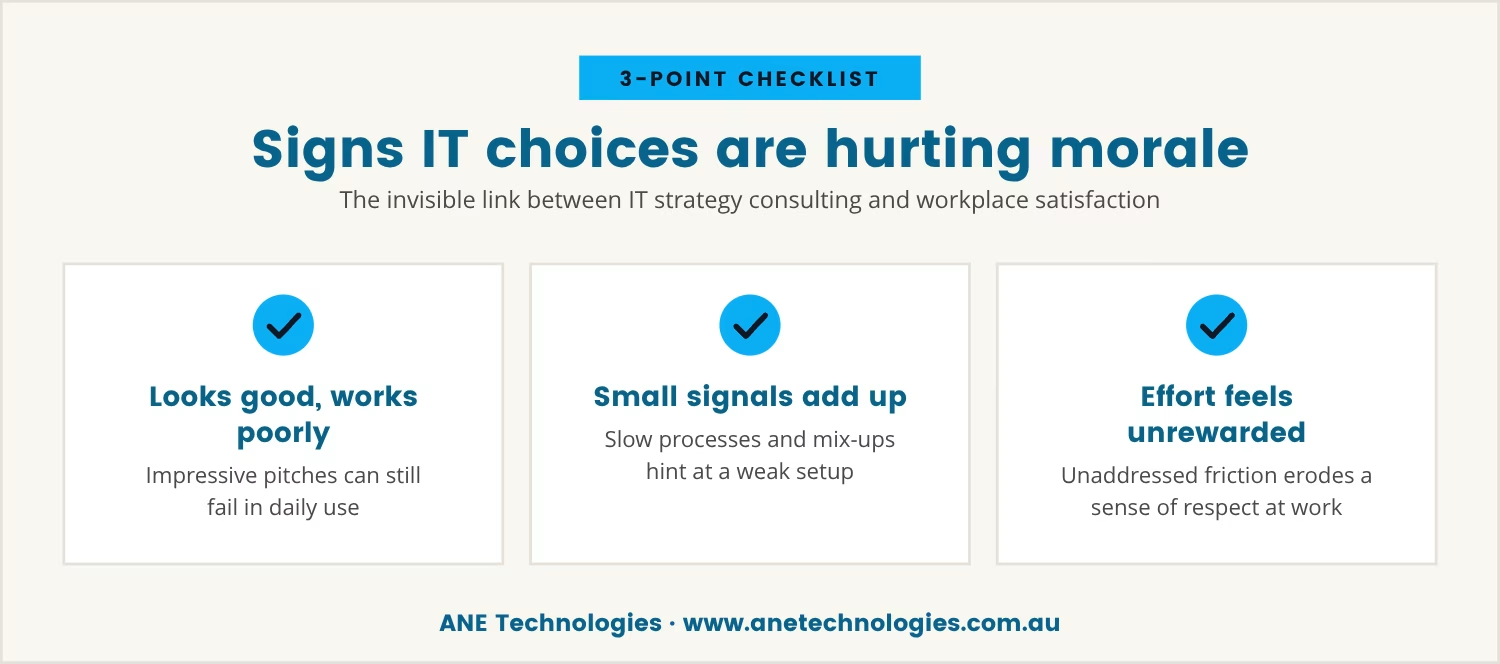
Skip that conversation, and technology decisions default to price tags or popularity rather than fit. The result can look impressive in a sales pitch while failing in practice.
Staff rarely file a formal complaint about a clunky system. More often the signs are indirect — a slow process here, a miscommunication there, a task that takes twice as long as it should. Each one is a small signal that the IT setup isn't pulling its weight.
Left unaddressed, those signals accumulate into something larger: a workplace where effort doesn't feel respected. Job satisfaction drops accordingly, even when nobody names the cause out loud.
IT consulting services are built to catch exactly these hidden problems before they settle into daily routine. Bringing a consultant in early means spotting friction points while they're still small, which leaves staff spending more time on real work and less time fighting their tools.
From there, a consultant builds a technology roadmap shaped around the business itself rather than borrowed from a competitor's playbook — accounting for current systems, future plans, and the way the team actually operates day to day.
When the technology genuinely fits, people notice. Work gets easier, communication improves, and confidence grows — all of which feeds directly into job satisfaction and makes a frustration-driven resignation far less likely.
Skip this step, though, and the cost shows up later, in the departure of people who were otherwise worth keeping.
The warning signs are often easy to miss because they rarely announce themselves. These are the patterns worth watching for:
Spotting more than one of these at once is usually a sign it's time to review the technology itself.
When systems don't do what they're meant to, staff absorb the difference in extra time and effort. Multiplied across a business, that lost time chips away at productivity and, eventually, at the bottom line.
Consider a team forced to manually re-enter data across systems that don't talk to each other — that's time lost every single day. Or consider confusing security services that staff quietly avoid using properly, which quietly increases the business's exposure to risk.
Left unresolved, these frictions breed a culture where people stop expecting things to work, and stop trying to make them better. Innovation stalls along with it, and opportunities go unexplored.
Addressing these problems early, with the help of IT security consulting or a managed IT services provider, heads off costs that would otherwise stay hidden until they're expensive.
A consultant's value lies in an outside view — spotting what's become invisible to people working inside the business every day. Here's how that typically plays out.
A consultant reviews the existing technology stack to find gaps, overlaps, or outdated tools quietly slowing people down.
Conversations with the team surface the daily friction points that never make it into a formal complaint.
The IT setup gets measured against real organisational objectives, not just technical checklists.
Advice is shaped around the business itself, prioritising changes that will shift the staff experience most.
A scalable roadmap keeps the technology capable of growing alongside the business, rather than falling behind it.
Guidance through the transition keeps disruption to a minimum as new systems come online.
Hesitation around consulting often comes down to treating it as an avoidable expense. Yet the real cost tends to surface later, once staff start leaving and the business is left hiring and training replacements — a process that eats time and disrupts operations in its own right.
Losing an experienced staff member also means losing the knowledge they carried, and new hires can take months to reach the same level of output. Meanwhile, the technology problem that pushed the last person out is still sitting there, waiting for the next one.
Investing in IT strategy consulting earlier avoids these compounding costs. More than preventing problems, it builds a workplace people have good reason to stay in.

We understand that businesses with 1 to 40 users often find it hard to spot the real cause of staff frustration until it’s too late. At ANE Technologies, we see how the right IT advice can make daily work smoother and more satisfying for your team.
If you’re ready to see how we approach technology planning to support staff retention, we invite you to start a conversation about your own setup. Let’s talk about what works—and what could work better.
If we ever miss a commitment, you’ll receive a $170 service credit—no questions asked, just our way of standing behind our word.
Frequent complaints about slow systems, confusing processes, or manual workarounds are a strong sign the technology isn't fitting the business properly. Consulting services help identify and fix these issues before they grow into bigger problems.
Managed IT services focus on the day-to-day running and support of technology, keeping things working smoothly. IT consulting instead helps plan, design, and improve systems so they better align with business goals.
Yes — technology consulting commonly includes a review of the cyber security setup. Consultants can identify risks, recommend improvements, and help build a safer environment for staff and data alike.
A consulting firm takes time to understand the specific processes and challenges a business faces, then recommends solutions customised to that organisation rather than a one-size-fits-all package.
A technology audit is a detailed review of current systems, software, and processes, aimed at identifying where improvements, streamlining, or upgrades would best support the team and its objectives.

With 20 years of industry experience and a strong background in business operations and process analysis, Rob understands how technology can be applied practically to improve commercial systems, workflows, and outcomes.

We help small businesses in Coopers Plains, Brisbane and across South-East QLD thrive with expert IT support.
Our engineers are experienced and committed to your success.